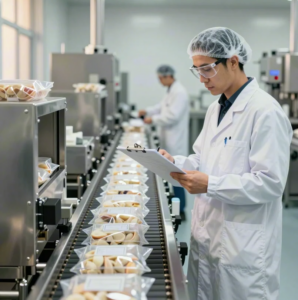
 Most plants think audit failures come from big, dramatic problems. They don’t. Most GMP non-conformances are small, repeated, ordinary failures: a door that doesn’t seal, a cleaning record signed in advance, an operator who can’t explain what the sign on the wall means.
This guide lists the 10 most common GMP non-conformances found in food audits, explains why each one is raised, and shows the practical fix. Use it as a checklist for GMP non-conformances before your next inspection.
What Are GMP Non-Conformances?
Good Manufacturing Practice (GMP) is the set of basic hygiene and operating conditions that keep food safe. It covers buildings, equipment, cleaning, pest control, personnel, and records.
A non-conformance is a failure to meet a requirement. It might be a rule in the law, in a standard such as BRCGS or FSSC 22000, or in your own written procedures. Auditors usually grade them as minor, major, or critical, depending on how directly the failure threatens food safety.
In the United States, the legal baseline is the current good manufacturing practice rule in 21 CFR Part 117. Certification schemes add their own detail on top.
Why GMP Non-Conformances Matter
A single finding rarely closes a plant. But GMP non-conformances add up, and they point to deeper problems.
Take the audit data. According to Food & Drink Technology’s review of audit results, more than 100,000 non-conformities were raised under BRCGS Food Safety Issue 9 in 2024. Manufacturers averaged just under five findings per audit, and about 59% fell under site standards. The most cited single requirement was clean and hygienic equipment and facilities.
In other words, the basics trip up more plants than complex technical controls do. That is good news, because basics are fixable.
Top 10 GMP Non-Conformances and How to Fix Them
1. Ineffective Pest Control
Pest control is the classic entry on any list of GMP non-conformances. In its fiscal year 2017 data, the FDA’s most frequent food inspection observation was lack of effective pest control, with 330 cases, according to Food Industry Executive’s summary. The data is old, but the pattern still holds in modern audits.
Typical findings include:
- Gaps under doors and around pipes where pests can enter
- Bait stations that are missing, damaged, or not checked on schedule
- Evidence of rodent droppings or insects near production or storage
- Pest reports that show trends but trigger no action
The fix:
- Walk the building perimeter and seal gaps, and fit door sweeps and screens.
- Map every trap and station, and check them against the contractor’s schedule.
- Review pest reports monthly, and act on any trend.
- Keep waste areas, dock doors, and drains clean, because they attract pests first.
2. Poor Cleaning and Sanitation
If one of the GMP non-conformances dominates modern audits, it is cleaning. The BRCGS clause covering clean and hygienic equipment and facilities was the most cited non-conformity in the 2024 to 2025 reporting period.
Auditors find product residue on machine surfaces, dirty overhead pipes, grease on conveyors, and sanitizer used at the wrong strength. Another common problem is a cleaning schedule that exists on paper but isn’t followed.
The fix:
- Write a master sanitation schedule that names what is cleaned, how, how often, with which chemical, and by whom.
- Train cleaners on contact times and dilution.
- Use ATP swabs or visual checks to verify results before production restarts.
- Include hard-to-reach spots, such as the underside of conveyors, in the schedule.
3. Damaged Floors, Walls, and Ceilings
Structural condition is a steady source of GMP non-conformances. In the FDA data above, floors, walls and ceilings, and general building sanitation each appeared among the top ten observations.
Cracked floors hold water and bacteria. Peeling paint and flaking ceiling surfaces can fall into product. Open drains and standing water create the damp conditions in which Listeria thrives.
The fix:
- Include structural checks in weekly GMP inspections.
- Repair cracks, holes, and failing surfaces quickly, and log the repair.
- Keep drainage working, and fix any area where water pools.
- Never leave a maintenance repair temporary without a date to finish it.
4. Harborage Areas and Poor Housekeeping
Clutter gives pests places to hide and makes cleaning impossible, so it generates GMP non-conformances in every department. FDA data lists harborage areas among its common observations, and auditors flag them everywhere from warehouses to staff rooms.
Examples include pallets stacked against walls, unused equipment left in corners, and boxes stored on the floor.
The fix:
- Keep a clear gap between stored goods and walls so inspectors and pest technicians can see the area.
- Remove unused equipment, or store it in a designated, cleaned area.
- Store items off the floor on racks or pallets.
- Run a short end-of-shift tidy check.
5. Weak Sanitation Monitoring and Verification
Cleaning is only half the job. You also have to show it worked. Sanitation monitoring appeared in the FDA’s top three observations in fiscal year 2017.
Auditors raise this type of GMP non-conformance when a plant cleans but doesn’t test. Without swabs, inspections, or environmental monitoring, nobody knows whether the cleaning actually removed the risk.
The fix:
- Set a verification plan with methods, frequencies, and limits.
- Use environmental swabs in high-risk areas, especially for Listeria in ready-to-eat plants.
- Review results as trends, not just single pass/fail readings.
- Define what happens when a result fails, and document the response.
6. Personnel Hygiene and Training Gaps
People carry contamination into food, and personnel are a leading source of GMP non-conformances. Auditors watch what staff do as closely as what they say.
Common findings include:
- Uncovered hair or beards
- Jewelry, watches, or loose items in production areas
- Handwashing skipped, or sinks without soap or towels
- Visitors and contractors entering without hygiene rules
- Training records that exist, but staff can’t explain the procedure
The fix:
- Put clear hygiene rules at every entrance, and enforce them for visitors too.
- Keep handwashing stations stocked and easy to reach.
- Test understanding, not just attendance, by asking operators to explain tasks.
- Refresh training regularly, and after any incident.
Habits matter more than posters. Our guide to food safety culture explains how to make good practice stick when no one is watching.
7. Allergen Cross-Contact and Labeling Errors
Allergen failures are among the most dangerous GMP non-conformances, because a single mistake can cause serious harm. Audit reviews note incorrect or missing allergen declarations and weak controls on foreign materials as recurring gaps.
Typical problems include shared equipment without validated cleaning, rework containing allergens that is added to the wrong product, and labels that don’t match the recipe.
The fix:
- Keep an allergen register that lists every ingredient and every product.
- Schedule production to minimize changeovers between allergen and non-allergen products.
- Validate allergen cleaning, using swabs or tests, not just visual checks.
- Check labels against the current recipe at every changeover.
- Control rework strictly, with clear identification and rules for use.
8. Weak Physical Contamination Controls
Glass, hard plastic, metal, and wood can all end up in food. These GMP non-conformances are serious because the hazard is physical and obvious. Auditors check whether you control these risks and whether your detection equipment actually works.
Findings include no glass and brittle plastic register, broken lights without covers, metal detectors that aren’t tested at the required frequency, and no procedure for what to do after a glass breakage.
The fix:
- Keep a register of glass and brittle plastics, and inspect it on schedule.
- Test metal detectors and X-ray units with certified test pieces at set intervals.
- Define the reject and hold procedure, and rehearse it.
- Store glass items carefully, as explained in our guide to glass containers for food storage.
9. Incomplete Records and Open Corrective Actions
Auditors say it constantly: if it isn’t written down, it didn’t happen. Weak records are one of the quickest ways to collect GMP non-conformances.
Typical problems are blank fields, pre-filled signatures, records completed at the end of the week from memory, and corrective actions that stay open for months. Another subtle one is a corrective action that fixes the symptom but never asks why it happened.
The fix:
- Fill in records at the time of the task, never later.
- Review records daily or weekly, and sign the review.
- Set due dates and owners for every corrective action.
- Ask “why” at least three times to find the root cause, and check later that the fix worked.
10. HACCP Plan Not Implemented as Written
The last of the common GMP non-conformances is a gap between the plan and reality. Auditors find a well-written HACCP plan on the shelf and a different process on the floor.
According to Food & Drink Technology, recurring HACCP gaps include incomplete hazard analysis, poorly defined critical control points, weak monitoring, and confusion between validation and verification. FDA data also lists HACCP plan implementation among its top ten observations.
The fix:
- Walk the process with the HACCP team and compare it with the flow diagram.
- Update the plan whenever a product, supplier, or machine changes.
- Make sure operators at each critical control point know the limits and what to do if they are missed.
- Validate that your limits really control the hazard.
For a worked example, see our HACCP plan template for dairy processing.
Summary Table: 10 GMP Non-Conformances at a Glance
| # | Non-Conformance | Typical Evidence | Quick Fix |
|---|---|---|---|
| 1 | Ineffective pest control | Gaps, damaged stations, droppings | Seal entry points, review pest trends |
| 2 | Poor cleaning and sanitation | Residue, dirty equipment | Master schedule and verification |
| 3 | Damaged floors, walls, ceilings | Cracks, peeling paint, standing water | Weekly structural checks |
| 4 | Harborage and poor housekeeping | Clutter, stock against walls | Clear gaps, remove unused items |
| 5 | Weak sanitation monitoring | No swabs or trend review | Verification plan and swabbing |
| 6 | Personnel hygiene gaps | Jewelry, skipped handwashing | Clear rules and competence checks |
| 7 | Allergen cross-contact | Wrong labels, shared lines | Register, validated cleaning |
| 8 | Physical contamination | No glass register, untested detector | Register and test pieces |
| 9 | Records and corrective actions | Blank or pre-filled logs | Real-time records, due dates |
| 10 | HACCP not implemented | Plan differs from practice | Walk the line, update the plan |
How to Prevent GMP Non-Conformances Before an Audit
Fixing GMP non-conformances after the audit is expensive. Preventing them is cheaper. These habits work in most plants.
Run Regular Internal GMP Inspections
A weekly walk-through by supervisors catches most problems before an outsider does. Use a simple checklist based on the ten findings above, and rotate the inspector so fresh eyes see old habits.
Hold Mock Audits
A mock audit by someone outside your site shows what a real auditor would write. Our audit and inspection services include mock inspections that rank findings by risk, so you know what to fix first.
Track Findings and Trends
Keep a log of every one of your GMP non-conformances, who owns it, and when it was closed. If the same problem appears three times, the real cause hasn’t been fixed. Look for patterns by area, shift, or supervisor.
Build a Culture Where People Report Problems
The best early warning system is a worker who points out a broken door seal and isn’t blamed for it. Encourage reporting, thank people for it, and fix issues quickly so that people see it works.
Connect GMP to Your Wider System
GMP is the foundation under HACCP, ISO 22000, and certification schemes. Our guide to food safety compliance systems shows how these parts fit together, so you don’t duplicate work or leave gaps.
How Auditors Grade GMP Non-Conformances
Grading of GMP non-conformances varies by scheme, but the logic is similar everywhere.
- Critical: A direct, immediate risk to food safety or legality, or a serious breakdown of the system. It can block or suspend certification.
- Major: A significant failure, or a pattern of minor ones, that raises doubt about whether a requirement is met. It usually needs a root cause analysis and corrective action within a short time frame.
- Minor: An isolated lapse that doesn’t threaten food safety directly. It still needs correction, but often with a longer deadline.
Always read the rules of your own scheme or regulator, because definitions and deadlines differ. Ask your certification body for its grading guide before the audit.
What to Do When You Receive a GMP Non-Conformance
A calm, structured response to GMP non-conformances protects your certificate and your credibility. Follow these steps:
- Contain the problem. Fix the immediate risk, such as holding affected product or cleaning the equipment.
- Find the root cause. Ask why the failure happened, not just what happened.
- Plan the corrective action. Set a clear action, an owner, and a due date.
- Plan the preventive action. Check whether the same weakness exists in other areas.
- Provide evidence. Photos, records, and test results show that you fixed it.
- Verify later. Return after a few weeks to confirm the problem has not come back.
Auditors respect honest, well-documented responses to GMP non-conformances. Vague or late answers raise more concern than the original finding.
FAQ
What is a GMP non-conformance? It is a failure to meet a good manufacturing practice requirement, whether set by law, a certification standard, or your own procedures. Auditors usually grade it as minor, major, or critical.
What are the most common GMP non-conformances in food factories? The most common GMP non-conformances include ineffective pest control, poor cleaning, damaged buildings, clutter, weak sanitation verification, hygiene lapses, allergen controls, physical contamination controls, incomplete records, and HACCP plans not followed in practice.
What is the difference between a major and a minor non-conformance? A minor non-conformance is an isolated lapse with limited risk. A major one is a serious failure, or a pattern of minor ones, that casts doubt on whether a requirement is met. Exact definitions depend on the scheme.
How long do I have to close a non-conformance? It depends on the scheme or regulator and the grade of the finding. Critical and major findings usually have short deadlines. Your certification body will give the exact dates in its report.
What is the difference between GMP and HACCP? GMP covers the basic hygiene and operating conditions of the whole plant. HACCP is a targeted system that controls specific hazards at critical points. GMP is the foundation that HACCP depends on.
Can a GMP non-conformance cause a failed audit? A single minor finding rarely will. But a critical finding, or several major ones, can lead to a failed audit or a suspended certificate. Repeated findings in one area are a warning sign.
How can I reduce GMP non-conformances quickly? To reduce GMP non-conformances, start with the basics: pest control, cleaning verification, housekeeping, and real-time records. Run a mock audit, fix the highest-risk items first, and track every finding to closure.
Do these findings apply outside the United States? Yes. The wording and the legal references differ, but GMP non-conformances in pest control, cleaning, personnel hygiene, allergen control, and records are checked in every major food safety system around the world.
Conclusion
GMP non-conformances are rarely mysterious. They come from pests, dirt, damaged buildings, clutter, careless habits, and paperwork that doesn’t match reality. The good news is that every one of the ten GMP non-conformances above can be prevented with routine checks and a team that cares.
Start with a weekly walk-through, close each finding with a root cause, and keep honest records. If you want an outside view, our team can run a mock audit and give you a ranked action list. Schedule a consultation to get started.