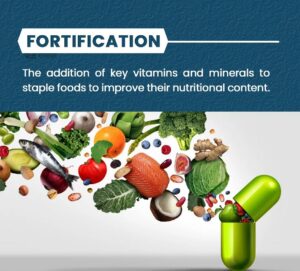
 Check the label on your breakfast cereal, your flour, or your table salt. Chances are a vitamin or mineral was added on purpose. That’s food fortification, and it’s one of the quietest, most effective public health tools ever developed.
This guide explains what food fortification is, how it works, seven facts worth knowing, the real-world results behind it, and where its limits are.
What Is Food Fortification?
Food fortification is the deliberate addition of essential vitamins or minerals to a food to improve the nutritional quality of the food supply. The goal is a public health benefit with minimal risk. That’s the working definition used by the World Health Organization and the Food and Agriculture Organization.
In practice, a manufacturer adds a measured nutrient premix to a staple food during processing. People then get the nutrient through foods they already eat, with no change in habits.
Fortification vs. Enrichment vs. Restoration
These terms get mixed up, and the differences are small but real:
- Fortification adds nutrients that weren’t naturally present, or adds more than the usual amount.
- Enrichment is often used for adding back nutrients lost in processing, such as B vitamins and iron in refined flour.
- Restoration specifically returns nutrients to their original levels after processing.
In everyday conversation, and in most regulations, the terms overlap. The key point is the same: nutrients are added on purpose, in controlled amounts.
Why Food Fortification Exists
Micronutrient deficiencies are often called “hidden hunger” because people can eat enough calories and still miss key vitamins and minerals. Global health agencies estimate that billions of people are affected by at least one deficiency.
The WHO’s guidelines on food fortification with micronutrients point to a key advantage. Food fortification can deliver nutrients to large parts of a population without requiring major changes in what people eat.
That matters because changing diets is slow and hard. Adding a nutrient to a food people already buy is far easier to scale.
7 Powerful Facts About Food Fortification
1. It Has Been Working for Roughly a Century
Food fortification isn’t new. Iodized salt was introduced in parts of the United States in the 1920s to reduce goiter. Vitamin D was added to milk in the following decades to help prevent rickets. Flour enrichment with B vitamins and iron followed.
Many of these programs were so successful that the diseases they targeted became rare in places that adopted them.
2. Folic Acid Fortification Cut Serious Birth Defects
The United States began requiring folic acid in enriched grain products in 1998, at 140 micrograms per 100 grams. According to the CDC’s summary of the research, the birth prevalence of neural tube defects dropped by about 35% after the requirement began.
The CDC also notes that fortification prevented many, but not all, of these defects. That’s why health authorities still recommend that women who could become pregnant get folic acid from other sources too.
3. There Are Several Different Types
The WHO describes a few main approaches:
- Mass fortification: adding nutrients to foods eaten widely by the general population, such as flour, salt, or cooking oil.
- Targeted fortification: fortifying foods designed for specific groups, such as infant cereals or school meals.
- Market-driven fortification: manufacturers choose to add nutrients to their products, often as a selling point.
Each has different goals, costs, and oversight needs.
4. It Can Be Mandatory or Voluntary
Some countries require fortification of specific staples by law. Others allow it voluntarily under regulated limits. Mandatory programs tend to reach more people because every producer of the staple food participates.
Voluntary programs give manufacturers flexibility, but coverage depends on how many companies choose to take part.
5. The Food Has to Match the Problem
Effective food fortification depends on choosing the right “vehicle,” meaning the food that carries the nutrient. A good vehicle is eaten regularly by most of the target population, doesn’t change much in taste or appearance, and keeps the nutrient stable through storage and cooking.
Salt, flour, rice, cooking oil, sugar, and milk are common vehicles for this reason.
6. Dosage Control Is Critical
Too little of a nutrient delivers no benefit. Too much can cause its own problems. That’s why food fortification programs depend on accurate premix dosing, routine testing, and regular monitoring.
For manufacturers, this makes fortification a quality control and food safety topic as much as a nutrition one. Our guide to food safety compliance systems explains how a documented system keeps processes like nutrient dosing consistent and verifiable.
7. It Complements a Good Diet, It Doesn’t Replace One
Fortified foods can close nutrient gaps, but they aren’t a substitute for varied, whole foods. A fortified breakfast cereal doesn’t offer the same range of nutrients and fiber as vegetables, legumes, and whole grains.
Think of food fortification as a safety net under a healthy diet rather than a shortcut around one.
Common Examples of Fortified Foods
| Food | Nutrient Commonly Added | Main Purpose |
|---|---|---|
| Table salt | Iodine | Prevent goiter and support thyroid function |
| Enriched flour and grains | Folic acid, iron, B vitamins | Reduce birth defects, prevent anemia |
| Milk | Vitamin D (and sometimes vitamin A) | Support bone health |
| Breakfast cereals | Iron, B vitamins, vitamin D | Fill common dietary gaps |
| Plant-based milks | Calcium, vitamin D, vitamin B12 | Match nutrients found in dairy milk |
| Cooking oil or sugar (some countries) | Vitamin A | Prevent vitamin A deficiency |
Exact products and nutrient levels vary by country, so check local regulations and the nutrition label.
The Benefits of Food Fortification
- Wide reach. It reaches people through foods they already eat, including those who never see a doctor or take supplements.
- Cost effectiveness. Adding a nutrient at the processing stage is generally inexpensive per person compared with many other health interventions.
- No behavior change needed. People don’t have to learn new habits or take a daily pill.
- Proven results. Programs like folic acid and iodine fortification have measurably reduced specific health problems.
Limits and Concerns
Food fortification works best when it’s designed carefully. It also has real limitations that deserve an honest look.
Overconsumption
Because fortified foods are widely available, people who eat large amounts of several fortified products, plus supplements, can exceed safe upper limits for some nutrients. This is a bigger concern for nutrients like vitamin A and iron than for water-soluble vitamins.
Masking Other Deficiencies
High folic acid intake can hide the signs of vitamin B12 deficiency, which matters particularly for older adults. This is one reason fortification levels are set cautiously and monitored over time.
Uneven Coverage
If a fortified food isn’t eaten by the people who need it most, the program misses its target. Rural or lower-income groups who buy unprocessed or locally milled staples may not benefit from industrially fortified products.
Quality and Enforcement
A fortification program is only as good as its quality control. If premix dosing drifts or nutrients degrade in storage, the food may not contain what the label says. Regular testing, supplier verification, and clear documentation are what keep programs reliable.
Food Fortification and Food Safety Compliance
For food producers, fortification adds specific tasks to a quality system:
- Accurate premix handling and storage
- Calibrated dosing equipment
- Routine nutrient testing of finished product
- Labeling that matches actual nutrient content
- Traceability for premix ingredients
These steps fit naturally into HACCP and GMP programs, and they’re a common focus during audits.
Myths About Fortified Foods
Fortified foods attract plenty of misconceptions, from “it’s all marketing” to “added vitamins don’t count.” Some are partly true and many are oversimplified. Our article on food science myths takes a similar fact-checking approach to other popular kitchen and nutrition claims.
Nutrient-rich whole foods are also worth remembering alongside fortified ones. For example, our guide to almond nutrition shows how a single whole food can supply vitamin E, magnesium, and fiber naturally.
FAQ
Is food fortification safe? When programs are designed and monitored properly, fortification is considered safe and effective by major health organizations. The main risks come from poor dosing or from very high combined intake across many fortified foods and supplements.
What’s the difference between fortified and enriched foods? Enriched usually means nutrients lost during processing were added back. Fortified usually means nutrients were added that weren’t there originally, or were added at higher levels. The terms are often used interchangeably in labeling.
Which foods are most commonly fortified? Salt, wheat and corn flour, rice, milk, breakfast cereals, cooking oil, and plant-based milk alternatives are among the most common, though it varies by country.
Does food fortification replace the need for supplements? Not necessarily. Some groups, such as women planning pregnancy, may still be advised to take supplements even with fortified foods in the diet. A healthcare provider can advise on individual needs.
Is fortification required by law? It depends on the country and the food. Some nations mandate fortification of staples like flour or salt, while others only allow voluntary fortification within set limits.
How do I know if a food is fortified? Check the ingredient list and nutrition facts panel. Added vitamins and minerals are listed there, often with the percentage of the daily value they provide.
Conclusion
Food fortification turns everyday staples into delivery systems for nutrients people might otherwise miss. Its track record on goiter, rickets, anemia, and neural tube defects shows how much impact a simple, well-run program can have.
It’s not a cure-all. Dosage, food choice, monitoring, and a varied diet all matter. For consumers, that means reading labels and eating a mix of whole and fortified foods. For producers, it means treating fortification as a controlled, documented part of the quality system.
This was well written.