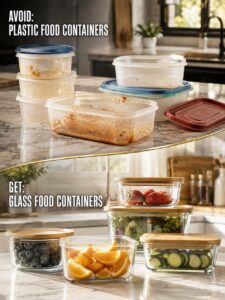
 Walk down the food storage aisle and you’ll see two main options: plastic containers that are light and cheap, and glass containers for food storage that cost a bit more upfront.
For years, plastic won on convenience alone. But a growing body of research on what happens to plastic when it’s heated, scratched, or reused has shifted that calculation for a lot of home cooks.
This guide breaks down the real differences between glass and plastic, seven evidence-based reasons glass tends to come out ahead, and where plastic still reasonably makes sense.
What’s the Difference Between Glass and Plastic Food Storage Containers?
Glass containers are made from a single, inert material that doesn’t react with food or absorb odors. Plastic containers are made from various polymer blends, often combined with additives like plasticizers, stabilizers, and colorants that can behave differently depending on the type of plastic and how it’s used.
That difference in material chemistry is the root of most of the practical differences described below.
7 Reasons to Choose Glass Containers for Food Storage
1. No Chemical Leaching Concerns
One of the clearest advantages of glass containers for food storage is that glass simply doesn’t leach chemicals into food, regardless of temperature or acidity. Plastic, by contrast, can contain compounds like BPA or phthalates depending on the resin type.
The FDA’s page on BPA in food contact applications notes that current safety assessments consider authorized uses of BPA to be safe at the levels typically encountered. Still, many consumers prefer to avoid the question entirely — which glass containers make simple, since there’s no plastic resin to worry about in the first place.
2. Far Fewer Microplastics When Reheating
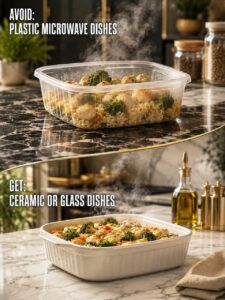 This is where the research has moved fastest in recent years. A 2023 study from the University of Nebraska–Lincoln, published in Environmental Science & Technology, found that microwaving certain plastic containers released millions of microplastic particles and billions of nanoplastic particles per square centimeter of container surface, within just three minutes of heating.
The same Nebraska research team’s summary found that even refrigerated or room-temperature storage released measurable particle counts over several months, though heating produced by far the largest releases. Glass containers for food storage don’t share this issue, since glass isn’t a polymer that can shed particles the way plastic can.
3. Naturally Oven, Microwave, and Freezer Safe
Most glass containers can move between the freezer, microwave, and a moderate oven without special “microwave-safe” labeling, since glass doesn’t soften or degrade at typical cooking and reheating temperatures.
Plastic containers vary widely — some are freezer-safe but not microwave-safe, others degrade with repeated reheating cycles. It’s often hard to tell which is which without checking the base of the container carefully.
4. Doesn’t Absorb Stains or Odors
Anyone who’s had a plastic container permanently tinted orange from tomato sauce knows this problem well. Plastic’s porous surface can absorb pigments and odors from strongly colored or aromatic foods over repeated use. Glass containers for food storage resist staining and odor absorption almost entirely, since the surface doesn’t have the same microscopic texture that traps residue.
5. More Durable Over the Long Term
Plastic containers degrade gradually — scratches accumulate, lids warp, and the material becomes brittle with age and repeated dishwasher cycles. Glass containers, while more fragile against drops, don’t degrade chemically or structurally with normal use, meaning a quality glass set can realistically outlast several generations of plastic replacements.
6. Easier and Safer to Clean
Glass tolerates high dishwasher heat and abrasive scrubbing without warping or scratching, which matters because scratched plastic surfaces are exactly where bacteria and residue are hardest to fully clean out.
A Food Safety Magazine review of packaging research also notes that older, scratched plastic containers released noticeably more microplastic particles than newer ones during heating — another point in favor of a material that doesn’t accumulate that kind of wear.
7. More Environmentally Sustainable
Glass is infinitely recyclable without losing quality, and a durable glass container avoids the repeated replacement cycle that plastic containers tend to require. For anyone weighing environmental impact alongside personal health, glass containers for food storage generally come out ahead over the container’s full lifecycle, even accounting for the higher energy cost of manufacturing glass initially.
When Plastic Still Makes Sense
None of this means plastic belongs nowhere in a kitchen. It’s worth being balanced here:
- Weight matters for travel or kids’ lunches. Plastic is lighter and more shatter-resistant, which matters for backpacks, lunch boxes, or households with young children.
- Cost can be a real barrier. A full glass container set costs more upfront than an equivalent plastic set, even though it may cost less over several years of replacement cycles.
- Not all plastic use involves heat. Cold storage of dry goods, for example, avoids the heating-related concerns that drive most of the research above.
The strongest, most evidence-backed case for switching applies specifically to reheating and long-term storage of leftovers — precisely the situations covered in our meal prep guide.
How to Switch to Glass Containers Without Overspending
- Start with the containers you use most. Replace whatever currently goes in the microwave first, since that’s where the research shows the biggest difference.
- Buy in stages. A full glass set isn’t required immediately — building up a collection over a few shopping trips spreads out the cost.
- Look for borosilicate glass for anything that moves between the freezer and oven, since it handles temperature swings better than standard soda-lime glass.
- Keep a few plastic pieces for their strengths. Lightweight plastic still makes sense for lunches, kids, and situations where breakage risk outweighs the benefits above.
Our kitchen essentials checklist covers container sizes worth prioritizing first if you’re building out a set from scratch.
Common Concerns About Glass Food Storage
- “Isn’t glass heavier?” Yes — this is the most common trade-off. It matters for portability but not for storage in a fridge or cabinet.
- “Won’t it break more easily?” Glass can chip or shatter if dropped on a hard surface, while many modern plastics flex instead. Tempered glass options reduce this risk somewhat.
- “Are the lids as good?” Lid quality varies by brand more than by material — look specifically at reviews of the sealing mechanism rather than assuming glass automatically means better lids.
FAQ
Is glass really better than plastic for food storage? For reheating and long-term storage specifically, the research on microplastic and chemical release gives glass a clear practical advantage. For cold, short-term, or portable storage, the difference matters less.
Do all plastic containers release microplastics when microwaved? Research shows release varies significantly by plastic type and container condition, with polypropylene and polyethylene containers studied most closely — but the safest approach for anything going in the microwave is to avoid plastic altogether rather than trying to identify which specific type is “safe enough.”
Is BPA-free plastic a good enough alternative to glass? BPA-free plastic avoids one specific compound, but other additives and the general issue of microplastic shedding under heat aren’t necessarily resolved just because a product is labeled BPA-free.
How long do glass containers for food storage typically last? With normal care, glass containers can last many years or even decades, since the material itself doesn’t degrade with routine washing and heating the way plastic does.
Can glass containers go straight from the freezer to the oven? Not usually — sudden temperature swings can crack most glass, including some tempered varieties. Letting a container come closer to room temperature before a hot oven, or choosing containers specifically rated for freezer-to-oven use, avoids this risk.
Conclusion
The case for glass containers for food storage isn’t about plastic being universally unsafe — it’s about avoiding unnecessary risk in the specific situations, like microwaving and long-term storage, where the research shows plastic performs worst.
Glass costs more upfront and weighs more in a bag, but it doesn’t leach chemicals, doesn’t shed microplastics, and tends to outlast plastic by years. For anyone reheating leftovers regularly, it’s one of the more evidence-backed swaps worth making in a kitchen.