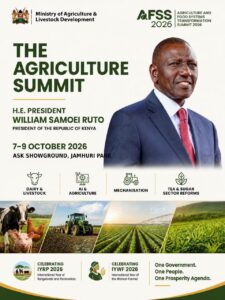
 The agriculture summit 2026 in Nairobi brought national and county governments, farmers, investors, and development partners together for three days at Jamhuri Park-ASK Grounds. Officially called the Agriculture & Food Systems Transformation Summit (AFSS 2026), it ran from October 7 to 9.
This guide explains what the summit is, its seven best takeaways so far, the sector tracks it covered, and what it could mean for farmers and food businesses.
What Is the Agriculture Summit 2026?
The agriculture summit 2026 is a national policy dialogue convened by Kenya’s Ministry of Agriculture and Livestock Development together with the Council of Governors. Its official theme is food sovereignty, job creation, and shared prosperity under the Bottom-Up Economic Transformation Agenda (BETA).
According to the official summit portal, each day is built around one guiding question:
- Day 1 (October 7): What has changed?
- Day 2 (October 8): What must Kenya choose?
- Day 3 (October 9): Who will deliver?
Attendance was open in person and virtually. The program mixed plenaries, ministerial and gubernatorial roundtables, breakaway sessions, a national exhibition, an innovation marketplace, and a youth challenge.
Why the Agriculture Summit 2026 Matters
Agriculture is central to Kenya’s economy, jobs, and household budgets. At the same time, the country relies on imports for several staples, and farmers face high input costs and climate risk.
The agriculture summit 2026 matters because it aims to end in commitments rather than speeches. The organizers planned a signed compact with accountability timelines, so progress can be tracked after the event.
7 Best Takeaways From the Agriculture Summit 2026
1. Cutting the Food Import Bill Is the Headline Goal
On Day 2, President William Ruto called for an overhaul of food production to reduce the country’s Sh3 trillion food import bill, according to Nation. He named edible oils, fats, wheat, and rice among the leading imports.
He also noted that many households spend more than half their income on food, which makes domestic production a cost-of-living issue as well as a farming one.
2. Farmer Registration Has Grown Sharply
On opening day, Deputy President Kithure Kindiki said the national farmer database had grown from about 300,000 farmers to 7.2 million crop farmers and three million livestock keepers, as reported by The Star.
He also credited the input subsidy programme with lowering the cost of supplies. A reliable registry matters because it underpins targeted subsidies, e-vouchers, and extension services.
3. Technology and Digital Infrastructure Take Center Stage
People Daily reported that the Deputy President backed precision farming, pointing to drones, improved crop varieties, and better livestock breeds. The same coverage linked the push to the threat El Niño poses to food supply.
The official program lists an Agricultural Digital Public Infrastructure blueprint as a key deliverable. It covers unified farmer registries, e-vouchers, soil mapping, and digital market data.
4. Production Gains Were Highlighted
President Ruto said milk production rose from about 4.5 billion to 5.6 billion litres, making Kenya the largest milk producer in Africa, as Citizen Digital reported. He also said rice output grew from about 192,000 tonnes to more than 300,000 tonnes.
These figures are government claims presented at the summit, so independent verification from sector data will be worth watching.
5. Post-Harvest Losses Are a Hidden Opportunity
Nairobi Governor Johnson Sakaja said Kenya loses about 40 percent of what it produces, roughly 9 million tonnes, according to coverage on Dawan Africa. He argued that halving those losses could feed an additional 7 million people.
This point links directly to storage, cold chains, drying, and safe handling, which are food safety topics as much as agricultural ones.
6. Value Addition Is Central to Farmer Income
The President cited tea as an example of why Kenya must capture more value from exports rather than shipping raw products. The official tracks reflect this, with dedicated sessions on tea, coffee, cotton, horticulture, sugar, dairy, and meat.
Several tracks cover processing, branding, quality, and traceability, not just production.
7. Youth Innovation Gets a Stage
The summit included a Youth Food Systems Innovation Challenge for young agri-entrepreneurs, with the top 10 finalists pitching on Day 3. A Deal Room matches those innovators with investors, development partners, and institutions that can help them scale.
Youth participation also shows up in the Founder Masterclass track and in the sector sessions.
Key Tracks at the Agriculture Summit 2026
Breakaway sessions ran in two rounds, covering the value chains and systems behind the headlines.
| Track Area | Examples of Topics |
|---|---|
| Strategic food crops | Maize, rice, wheat, seed and fertilizer access, aflatoxin control, storage, fortification |
| Export and industrial crops | Tea, coffee, cotton, horticulture, avocado, nuts |
| Livestock | Animal health, food safety, meat, dairy, policy reform |
| Sugar | Seedcane, cane pricing, mill competitiveness, farmer returns |
| Fisheries and blue economy | Aquaculture, landing sites, cold chains, safe processing |
| Land, water, irrigation | Tenure, water allocation, irrigation schemes |
| Forestry and regeneration | Restoration, agroforestry, soil health |
| Governance | Coordination between national and county governments |
Who Took Part
The accreditation categories on the portal included government and county officials, farmers and producers, private sector, financial institutions, researchers, civil society, youth, women, media, and consumers.
Development partners listed include FAO, AGRA, GIZ, CGIAR centers, and UN Women. The program also featured more than 150 exhibition booths and a National Farmers and Food Systems Awards gala on October 9.
What Happens Next: The Delivery Compact
The official plan for the final day is a signed compact setting out responsibilities, financing, and accountability. Planned deliverables include:
- A National Agriculture Compact for 2026 to 2030 with measurable production and investment targets
- A Digital Public Infrastructure blueprint for agriculture
- A de-risked agri-finance facility aimed at unlocking more than KES 100 billion in affordable credit for farmers
At the time of writing, the final outcomes had not been published. Check the official portal and ministry announcements for the signed commitments and timelines.
What It Means for Food Businesses
Several summit themes connect directly to quality and safety. Aflatoxin control in maize, grading and storage standards, and milling and fortification all affect what reaches consumers.
For more on these topics, see our articles on grain grading and food fortification. Producers and processors can also review our guide to food safety compliance systems to see how documented controls support market access.
If you’re comparing this event with others around the world, our overview of the best agriculture and food summit events in 2026 covers several more.
FAQ
When and where was the agriculture summit 2026? It took place from October 7 to 9, 2026 at Jamhuri Park-ASK Grounds in Nairobi, Kenya.
Who organized the agriculture summit 2026? It was convened by the Ministry of Agriculture and Livestock Development together with the Council of Governors, with support from several development partners.
Could people attend virtually? Yes. The official portal lists both in-person and virtual participation.
What is BETA? BETA is the Bottom-Up Economic Transformation Agenda, the government framework that the summit’s theme and objectives are tied to. Agriculture is one of its core pillars.
Where can I find the summit programme and resources? The official portal hosts the full programme, breakaway session packs, and downloadable resources.
What did the summit aim to produce? The stated aims were a national compact for 2026 to 2030, a digital infrastructure blueprint for agriculture, and a facility to expand affordable farm credit.
Conclusion
The agriculture summit 2026 put food sovereignty, farmer incomes, and delivery accountability at the center of Kenya’s agriculture agenda. The strongest signals from the first two days were the push to cut imports, expand digital registries and precision tools, and reduce post-harvest losses.
The real test comes after the event. Signed commitments mean little unless they turn into funded, measurable progress for farmers, processors, and consumers.