 Two facilities can have identical HACCP plans, the same GMP checklist, and the same certification on the wall and still get very different audit results. The difference usually isn’t the paperwork. It’s food safety culture: whether staff actually believe the rules matter and follow them when no one’s watching. This guide explains what that culture is, why auditors and certification bodies increasingly test for it directly, and breaks down the seven elements that separate a facility with a genuinely working culture from one that just has a policy manual on the shelf.
What Is Food Safety Culture?
Food safety culture is the shared set of values, beliefs, and everyday habits that shape how people in a facility actually behave around hazards, hygiene, and hazard controls not what the policy manual says they should do. It shows up in small, unscripted moments: whether an employee reports a broken thermometer instead of guessing, whether a supervisor stops the line over a minor deviation, or whether “we’ve always done it this way” wins out over the written procedure.
A useful way to think about it: your HACCP plan and SOPs describe the system you designed. The organizational culture around food safety is the system you actually get, once real people run it under real pressure tight shifts, short staffing, and production deadlines included. Two plants can be handed the same written procedures and end up with completely different day-to-day outcomes, purely because of how people were led, trained, and treated when they raised a concern.
Why It Matters More Than a Written Policy
Regulators have started saying this explicitly rather than leaving it implied. The FDA’s New Era of Smarter Food Safety initiative names food safety culture as one of its core pillars, alongside technology and traceability — a signal that documentation alone is no longer treated as sufficient evidence of a working system. Certification bodies have followed suit: GFSI-benchmarked schemes increasingly ask auditors to assess behavioral and organizational indicators, not just paperwork.
That shift matters because facilities with a healthy internal culture around food safety tend to catch problems before they become non-conformances. A workplace where staff feel safe flagging issues finds its own gaps. A workplace that only values a clean audit report tends to hide them instead and those hidden gaps eventually surface at the worst possible time, usually during a customer or regulatory audit.
There’s also a financial argument, even if it’s harder to put on a spreadsheet than a certification fee. Recalls, customer-relationship damage, and lost contracts almost always trace back to a gap between what the paperwork said and what actually happened on the floor. A documented HACCP plan doesn’t prevent a recall by itself the people executing it, hour by hour, do. Investing in food safety culture is, in that sense, less an HR initiative and more a direct risk-reduction strategy that happens to also make audits go more smoothly.
The 7 Elements of a Strong Food Safety Culture
Most established models, including the GFSI Food Safety Culture position paper, converge on a similar set of building blocks. Strengthening food safety culture means working on all seven elements together, not picking one and hoping it carries the rest.
1. Leadership Commitment
Culture takes its cues from the top. If leadership visibly prioritizes production speed over stopping the line for a safety issue, staff learn that lesson fast regardless of what any policy says. Visible, consistent leadership behavior (showing up for audits, funding fixes promptly, publicly backing staff who raise concerns) is the single strongest driver of a healthy environment in most facilities. Leaders don’t need to be food safety experts themselves, but their choices need to consistently signal that safety outranks speed.
2. Two-Way Communication
A strong food safety culture depends on real two-way communication not just management issuing directives, but frontline staff having a genuine channel to report problems without fear of blame. Facilities with the healthiest track records tend to treat near-misses as learning opportunities rather than incidents to punish. Where communication only flows downward, employees quietly stop passing bad news upward, and small issues fester until they become large ones.
3. Accountability at Every Level
Accountability means consequences and recognition apply evenly supervisors are held to the same standard as line workers, and shortcuts aren’t quietly tolerated because someone is a high performer in other respects. Uneven accountability is one of the fastest ways to erode trust in a system, because staff notice immediately when rules apply to some people and not others.
4. Continuous Training and Reinforcement
One-time onboarding training builds compliance on day one; it doesn’t build lasting habits. A workforce that sustains good practice over time requires ongoing reinforcement refreshers, visible reminders on the floor, and training that explains why a step matters, not just what to do. (See our food safety training programs for how ongoing reinforcement is typically structured.)
5. Systems Alignment
Good habits are easier to sustain when the underlying systems support them rather than fight them. A confusing SOP or an unrealistic HACCP monitoring schedule practically guarantees workarounds. For the relationship between these underlying systems and daily behavior, see our guide to food safety compliance systems the formal system and the human behavior around it are two halves of the same problem.
6. Psychological Safety
Employees need to genuinely believe that reporting a mistake, a near-miss, or a broken piece of equipment won’t get them blamed or punished. Without this, self-reporting quietly disappears, and management loses its earliest warning system for emerging risks. Psychological safety is built slowly, through consistent, calm responses to reported problems, and destroyed quickly by even one harsh reaction to a good-faith report.
7. Recognition and Continuous Improvement
Facilities that publicly recognize staff for catching problems rather than only correcting people for missing them reinforce the behaviors they actually want repeated. Pairing recognition with a visible cycle of “we heard this concern, and here’s what changed” closes the loop and shows staff their input has real consequences.
Compliance vs. Culture: What’s the Real Difference?
It helps to see the two side by side, since teams often conflate them and end up investing only in one.
| Compliance Systems | The Human Side | |
|---|---|---|
| What it is | HACCP plans, GMP programs, SOPs, records | Everyday behavior, beliefs, and habits around those systems |
| Where it lives | Binders, digital records, audit files | Shift conversations, supervisor decisions, unwritten norms |
| How it’s tested | Document review, record checks | Behavioral observation, staff surveys, near-miss rates |
| What it catches | Missing or outdated procedures | Workarounds, silent non-reporting, inconsistent enforcement |
| Who drives it | Quality/compliance team | Leadership at every level, reinforced daily |
Strong facilities invest in both columns at once. A facility that only builds the left column ends up with excellent paperwork and a floor that quietly does something different; a facility that only focuses on the right column without solid underlying systems has nothing concrete to reinforce.
What This Looks Like in Practice
The specifics vary by operation size, but the underlying pattern is consistent. In a small bakery, it might look like the owner personally stopping production over a temperature deviation in full view of staff, rather than quietly noting it and moving on a visible, low-cost signal that carries real weight precisely because everyone sees it happen. In a large multi-shift processing plant, it tends to look more structural: a documented near-miss reporting system that supervisors are measured on using, monthly floor walks by plant management (not just the quality team), and recognition given publicly when a line worker catches something before it became a problem.
What both examples share is that the behavior is visible, consistent, and modeled by whoever holds authority in that specific setting not delegated entirely to a policy document or a single training session. In both cases, food safety culture is being reinforced through action rather than instruction, which is precisely why it tends to stick longer than anything communicated only through a memo or a laminated poster.
A Real-World Example
Consider a mid-sized meat processor that had passed every documented audit for three years running but kept experiencing recurring minor non-conformances tied to the same handful of process steps. A behavioral review separate from the standard compliance audit found that supervisors on the night shift routinely waved through minor temperature deviations to keep production on schedule, while the day shift stopped the line for the same deviations without hesitation. The written procedure was identical for both shifts; the food safety culture was not.
The fix wasn’t a new SOP. It was retraining night-shift supervisors on stop-line authority, having plant leadership walk the night shift monthly (not just the day shift), and publicly recognizing the first night-shift stoppage that followed. Within two quarters, the recurring non-conformance stopped appearing in audits not because the written system changed, but because the food safety culture on that shift finally matched the one already present during the day.
Tools and Resources for Building Food Safety Culture
Several practical tools can support the work described above, beyond the GFSI-aligned assessment modules mentioned earlier:
- Anonymous survey platforms (e.g., general employee-engagement survey tools, adapted with food-safety-specific questions) to track psychological safety and reporting comfort over time
- Near-miss reporting systems even a simple shared log or reporting app, as long as it’s actually used and reviewed regularly by leadership
- Behavioral observation checklists used during routine floor walks, separate from formal audit checklists, to track patterns rather than one-off violations
- Recognition programs built into existing shift meetings or communication boards, so positive reinforcement happens close to the moment it’s earned
None of these tools build food safety culture on their own they’re only useful if leadership consistently acts on what they reveal.
How to Measure Food Safety Culture
Food safety culture is harder to quantify than a HACCP log, but it isn’t unmeasurable. Common assessment approaches include:
- Staff surveys anonymous questions about whether employees feel comfortable reporting issues and whether they believe leadership prioritizes safety over speed
- Behavioral observation audits trained observers watching actual floor behavior against written procedure, separate from a standard compliance audit
- Near-miss and self-reported incident rates a rising rate of self-reported near-misses is often a good sign, indicating psychological safety rather than a worsening problem
- GFSI-aligned assessment tools several GFSI-benchmarked certification schemes now include structured culture assessment modules as part of certification, scoring facilities on communication, leadership visibility, and accountability
Tracking these indicators over time quarterly surveys, periodic behavioral audits tends to reveal trends long before they show up as an audit finding.
Common Mistakes When Building Food Safety Culture
- Treating it as a poster campaign. Slogans on the wall change nothing if leadership behavior doesn’t change alongside them.
- Punishing near-miss reports. One harsh reaction to a good-faith report can undo months of trust-building.
- Applying rules unevenly. Exempting high performers from standard accountability quietly signals that the rules are optional.
- Retraining without reinforcement. A single annual refresher rarely survives contact with a busy shift; reinforcement needs to be ongoing and visible.
- Measuring only compliance, never behavior. A clean paper trail can coexist with widespread quiet workarounds on the floor.
Building Food Safety Culture: Where to Start
Meaningful change doesn’t start with a poster campaign. It starts with an honest assessment of where leadership behavior, communication, and daily practice currently diverge from the written system then closing that gap deliberately, starting with the most visible leadership behaviors. Our audit and assessment services include a dedicated culture component alongside the standard compliance review, so behavioral gaps surface alongside documentation gaps rather than staying hidden.
A realistic starting sequence looks like this: assess current behavior and communication patterns, identify the two or three leadership behaviors most visibly out of step with the written system, fix those first, then layer in ongoing training reinforcement and a recognition process. Facilities that try to fix all seven elements simultaneously often stall; sequencing the highest-impact leadership changes first tends to produce faster, more durable results.
Ready to assess where your organization stands? Schedule a consultation to start with a combined behavioral and compliance gap analysis.
FAQ
What’s the difference between food safety culture and food safety compliance? Compliance is whether your documented systems (HACCP, GMP, SOPs) meet the required standard. This concept describes whether staff actually follow those systems day-to-day, especially under pressure. A facility can be compliant on paper and still have weak underlying habits.
Can a small food business build a strong food safety culture? Yes this depends more on consistent leadership behavior and communication than on facility size or budget. Some of the strongest examples exist in small operations where leadership is directly visible on the floor every day.
Do auditors actually assess food safety culture directly? Increasingly, yes. Several GFSI-benchmarked certification schemes now include specific assessment questions or modules covering communication, leadership visibility, and accountability, separate from the standard documentation and process review.
How long does it take to change a food safety culture? Typically months, not weeks, since it depends on staff observing consistent leadership behavior over time rather than a single training session or policy update.
Who is responsible for driving food safety culture inside a company? Ultimately senior leadership, since staff take their cues from leadership behavior but quality managers and supervisors are usually the ones who translate that commitment into a working food safety culture on the floor.
Does food safety culture differ by shift or department, even within the same facility? Yes, and this is one of the most common blind spots. As the meat processor example above shows, a single written procedure can produce two very different cultures across shifts if supervisors enforce it inconsistently. Behavioral audits that sample multiple shifts, not just the one leadership happens to walk most often, are the most reliable way to catch this.
It’s worth setting expectations honestly at the outset: building food safety culture is not a project with a fixed end date the way installing a new HACCP plan can be. It’s an ongoing management discipline, similar to safety culture work in other high-risk industries, that needs to be revisited every time leadership changes, the facility grows, or a new shift is added. Facilities that treat the first assessment as a one-time fix tend to see the same behavioral gaps resurface within a year or two, usually right around the next round of staff turnover.
Conclusion
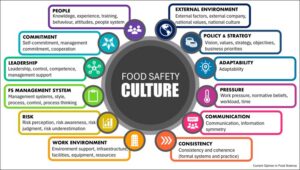 A written food safety system tells you what’s supposed to happen. The sven elements above determine what actually happens when no one’s checking: leadership commitment, real two-way communication, even-handed accountability, ongoing training, systems that support rather than fight daily practice, psychological safety, and recognition that closes the loop. Facilities that treat this side of the operation as seriously as documentation tend to catch their own problems before an auditor does.